
AI data centres: quantifying the gas burn
How much natural gas will America’s AI boom really need? Our new Constraint Model puts numbers to the narratives

For more than a decade, the US natural gas market has been defined by abundance. Production growth was fast, costs fell, bottlenecks were temporary, and every new source of demand — power consumption, LNG exports, industrial use — was ultimately absorbed by another wave of shale supply. Prices spiked occasionally, but structurally the system felt loose.
That sense of slack is now being tested from multiple directions at once.
The second wave of US LNG exports is still ramping, with several large projects scheduled to start up over a few short years. At the same time, upstream growth looks less elastic than it once did: core shale basins are more mature, capital discipline remains a constraint, and unlocking dedicated new gas supply requires structurally higher prices than associated gas wells tied to oil economics.
Overlay all of that with surging buildout of power-hungry artificial intelligence (AI) data centres, and the old assumption that supply will always stretch to meet demand starts to look less secure.
What makes this moment tricky is not just the scale of these forces, but how closely they are intertwined and the absence of coordination. There is no overarching masterplan guiding the role of gas in AI energy consumption, US LNG exports and shale supply. The big trade-off decisions are being left to the market, the ultimate arbiter of efficiency.
The trouble is, efficiency in one subdomain of the gas market can have unintended consequences in others, especially in a market at tipping into a structurally tighter price regime. If securing marginal natural gas supply becomes a zero-sum game, which part of the economy wins — and at whose expense?
LNG exports pull domestic gas supply into long-term, relatively inflexible global contracts. Data centres demand reliability and uptime, not just cheap electrons. Upstream supply responds with lags, uncertainty, and rising marginal costs. The result is a gas market structurally prone to shocks and lacking a means of self-regulating supply-demand imbalances.
And yet, despite the growing focus on AI power demand in headlines, there is surprisingly little rigorous, transparent modelling that tries to quantify what this might actually mean for US gas balances and the LNG export boom. Most commentary oscillates between breathless claims of a new “electricity supercycle” and casual dismissal: “shale gas is infinitely scalable, efficiency gains will fix this”. Neither extreme is particularly helpful.
This subscriber-only Deep Dive mini-series is an attempt to sit in the uncomfortable middle. To bring nuance and an analytical framework to a space defined by hype, fear and complacency.
This first instalment focuses on the US power sector, and specifically the ~250 GW pipeline of gas power plants being developed to meet rising electricity demand, including from AI data centres.
Rather than starting with price forecasts, ideological biases or sweeping conclusions, the approach is to create plausible capacity deployment pathways out to 2035.
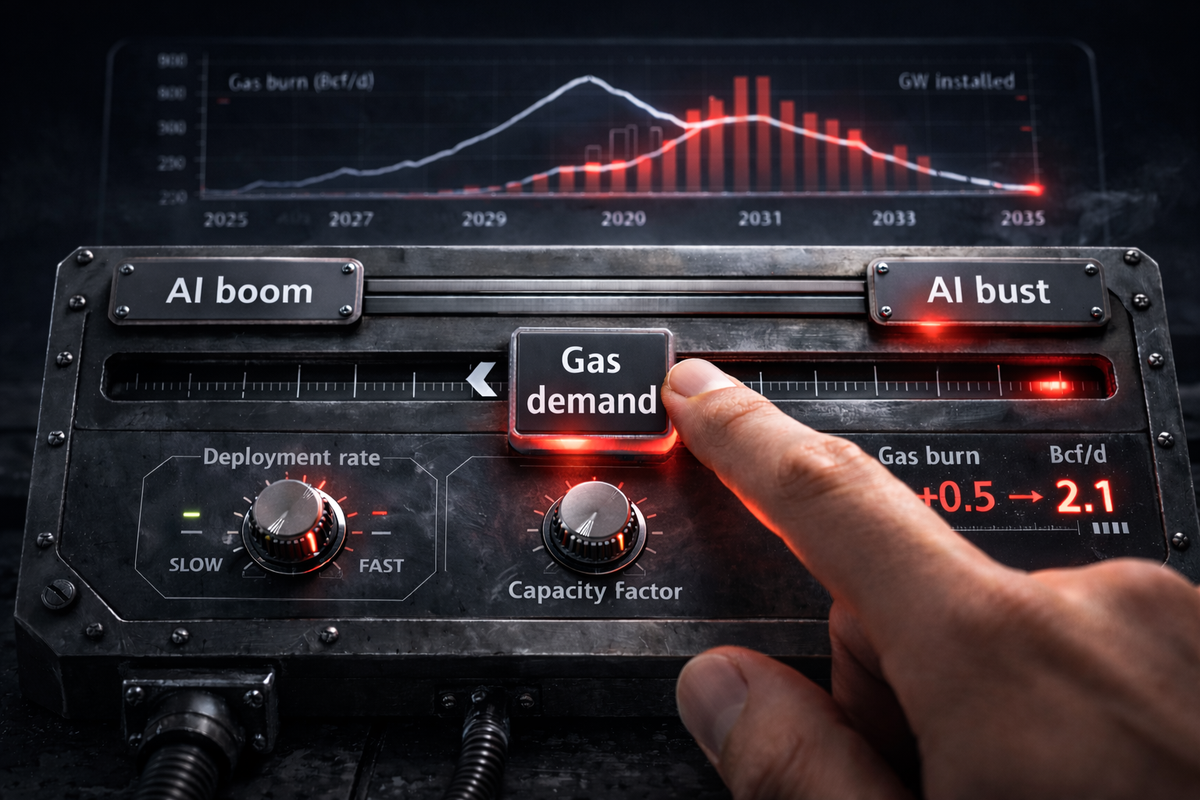
To do this, Energy Flux is today publishing a proprietary constraint model that creates a range of outcome scenarios for the American market. The model uses defensible assumptions to see where the pressure points emerge. Think of it less as a forecast and more as a data voyage into uncertain territory: mapping what could happen if stated intentions start to collide.
The question is simple but surprisingly hard to answer: If America’s gas-fired power pipeline actually materialises, even partially, how much additional gas demand could it plausibly create?
Key findings: AI could make or break the US gas market 👇
The first run of the Constraint Model delivered some useful insights.
- If the AI boom goes bust and data centres use gas mostly as a back-up power source, additional gas power burn in 2030 could be as little as 2 Bcf/d (+6% above the Energy Information Administration baseline)
- In the most likely scenario characterised by heavy usage of limited capacity for energy-intensive AI model training runs, that figure could rise to around 5 Bcf/d (+15% above EIA baseline)
- If gas turbine lead times are shortened and capacity installation rates surprise to the upside, data centre gas burn could exceed 10 Bcf/d (+30% above EIA baseline)
- Regardless of capacity and utilisation, gas power generation peaks in 2032 in all scenarios as renewables, storage, and price-responsive dispatch start to dominate America’s electricity mix.
The second instalment in this series, due in the coming weeks, will take these incremental power-sector gas demand scenarios and place them alongside US LNG ramp-up and upstream supply trajectories, to see where tensions emerge and what would have to give for the market to balance.
This matters beyond the US because global gas markets are increasingly tethered to Henry Hub, the benchmark traded gas price. More US LNG means more Henry Hub-indexed supply feeding Europe and Asia. Structural shifts in US domestic gas balances therefore don’t stay domestic for long: they ripple outward, with global consequences.
There is widespread speculation (not least on these very pages) that the AI boom might be the straw that breaks the camel’s back. Part two will test that hypothesis with rigorous data-driven analysis.
Before we get there, though, we need to understand the power sector piece properly. That’s the focus of today’s article.
Why subscribe?
This is not a Hot Take or a one-chart story. It’s a methodical, adaptable solution to a problem that will define gas and LNG markets well into the next decade.
Subscribers on the Premium and Deep Dive tiers get full access to the Constraint Model, customisable assumptions, caveats, and scenario logic; not just the high-level conclusions.
If you need an analytical tool for weighing up the competing demands on US natural gas, this series is for you.
💥 Article stats: 3,800 words, 14-min reading time, 9 charts & tables, 1 interactive Data Model download

Member discussion: AI data centres: quantifying the gas burn
Read what members are saying. Subscribe to join the conversation.