The storage-speculation nexus: revisited
Our revamped Chart Deck reveals hedge funds are again positioned to capitalise on Europe’s daunting gas storage refilling challenge

Hedge funds are back in familiar territory.
Once again, speculative capital is piling into prompt and summer-dated Dutch TTF gas futures contracts, positioning to profit from Europe’s annual gas refill challenge.
Proprietary analysis by Energy Flux reveals investment funds are placing big bets on EU gas prices rising over the summer months, driven by the need to enter next winter with enough of the fuel held in storage to avoid physical shortages.
On the surface, this looks like a replay of the past few years. But the underlying driver has changed, and that’s what makes the current setup more revealing.
Previously, this trade thrived because rigid EU storage mandates made refill demand predictable and non-negotiable. Funds could front-run a regulatory requirement, go long summer, and let policy do the rest.
This year, the scaffolding has been loosened. Storage targets were relaxed. Europe entered winter with lower inventories than in recent years. And yet the trade is back, arguably stronger.
Why? Because Europe is leaving winter with storages depleted to their lowest level since the unprecedented energy crisis of 2022.
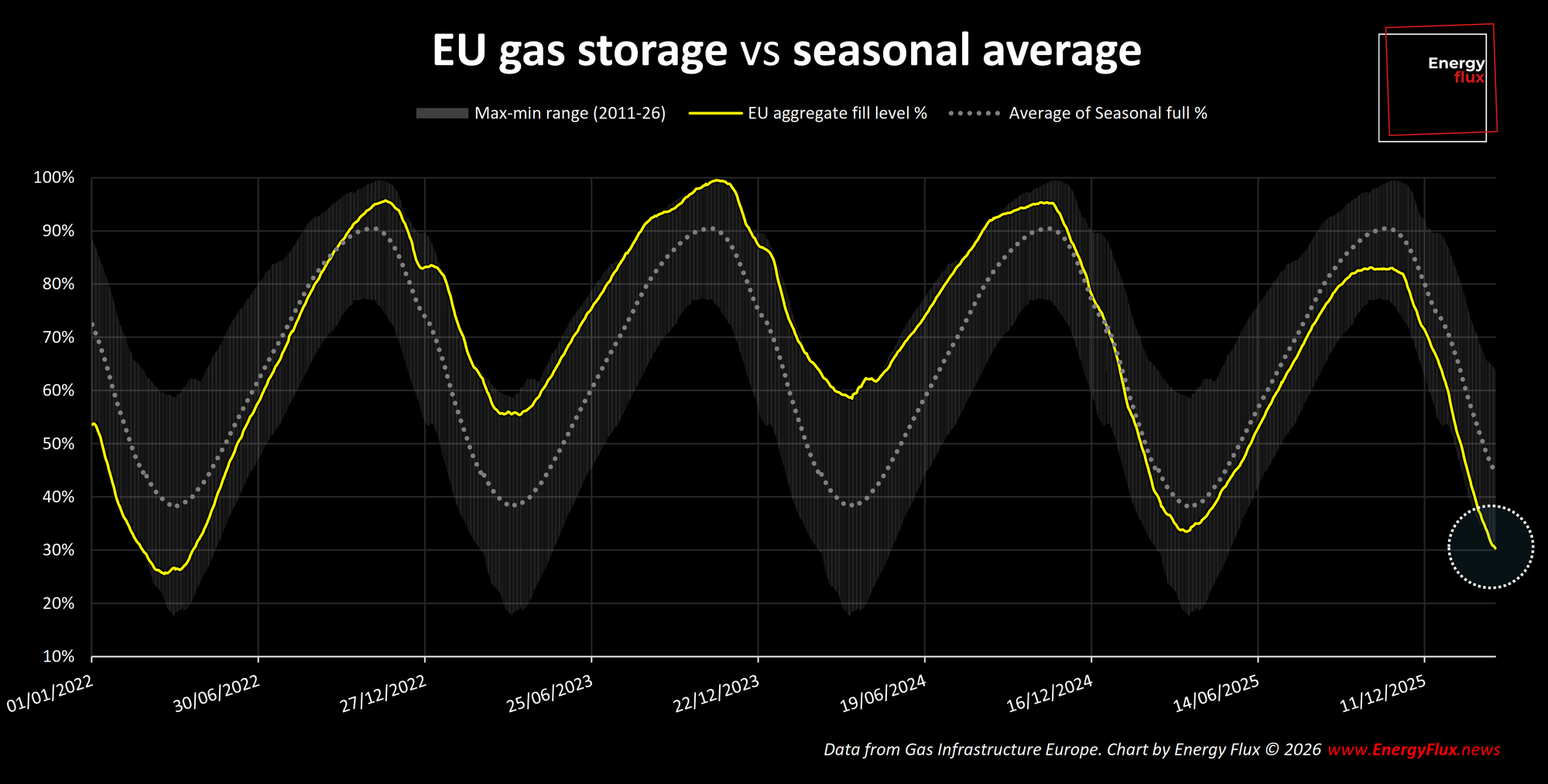
EU storage operators now need to buy a lot more gas simply to return to a credible energy-security buffer ahead of next winter. Not because Brussels says so, but because the European energy system is still hopelessly reliant on gas and LNG to function.
The result is the same familiar ritual:
- Exit winter with acutely depleted storage levels (and headlines screaming about impending doom)
- Spend the summer scrambling to restock in a haphazard, uncoordinated way
- Create a clean, calendar-driven opportunity for financial players to extract value
Europe may have stepped away from rigid mandates, but it has not escaped the Storage-Speculation Nexus. It has merely replaced regulatory certainty with structural necessity. Different rationale, same outcome.
What the market is telling us now
Current positioning shows speculative interest crowded into the front and mid-curve, with notable focus on summer delivery months relative to the winter 2026-27 contracts.
This is a strong indicator that investment funds are holding long positions and options in maturities that coincide with the refilling season. Evidently, funds see little upside once Europe moves beyond the next refill cycle.
Energy Flux analysis reveals that this structure has been in place since the violent short squeeze in mid-January, which forced funds into prompt contracts and never really unwound. The curve didn’t revert; it reorganised around the ‘gas storage refill stress’ trade.
While headlines scream of (misplaced) panic, the market is quietly pricing in predictable procurement pressure. This is entirely rational in a deregulated, liberalised market that relies on market mechanisms and price signals to achieve energy security objectives.
What is The Storage-Speculation Nexus?
Fund behaviour was first mapped out in a three-part Deep Dive series, which was published in Energy Flux in 2024 and early 2025 (see The Storage-Speculation Nexus, parts one, two and three).
The series asked a simple but often overlooked question:
- Which TTF contracts are speculators actually trading?
Rather than taking at face value the aggregate net long/short position published in the ICE Endex Commitment of Traders report, the research used regression analysis to show that capital concentrates in specific calendar months. Usually, those most exposed to storage refilling dynamics.
That work later formed the basis of my Gastech 2025 presentation. I subsequently recorded a walkthrough for those who couldn’t attend; if you want a full explanation of the methodology, this is a good place to start (check it out via this link).
Mapping the storage-speculation nexus, every week
Previously, this insight was delivered only periodically via bespoke analysis published in standalone Deep Dives. Now, that work has been fully embedded into the Energy Flux Chart Deck.
Subscribers on the Premium and Chart Deck tiers can now track, on a rolling weekly basis:
- Where speculative capital is concentrating along the TTF curve
- How that focus shifts as storage pressure builds or eases
- When the market is trading refill stress, and when it isn’t
At the same time, the Chart Deck has been expanded with more granular EU gas storage analysis, including:
- Weekly storage levels versus seasonal norms
- Weekly injection and withdrawal rates relative to historical averages
Together, these tools make it easier to see how Europe’s physical constraints translate into financial behaviour, without needing to infer intent from price action alone.
Why this matters
Europe keeps telling itself that each year is different. The market keeps proving otherwise.
Whether driven by regulation or necessity, the outcome is the same: summer refilling becomes a tradable event, and TTF remains an easy venue for short-term capital to monetise it.
The revamped Chart Deck is designed to track that process as it unfolds: clearly, consistently, and without the noise.
If you want to understand where the EU gas market is trading risk, the Chart Deck is built for you.
Subscribers get full access to weekly insight into speculative positioning, storage stress, and the invisible parts of the TTF curve that actually matter.
This includes the TTF Risk Model, TTF Sentiment Tracker, global FOB LNG netbacks & inter-basin arbitrage analysis, Asian LNG oil indexation competitiveness, global LNG flows by region, LNG glut tracker, and lots more...
💥 DOWNLOAD NOW: 90+ slides in .ppsx and .pdf format 👇

Member discussion: The storage-speculation nexus: revisited
Read what members are saying. Subscribe to join the conversation.