Venezuela: what happens next?
Chaos looms after audacious decapitation of Maduro regime

Aside from upending my publishing schedule and bringing a premature end to the holiday period, the dramatic events in Caracas over the weekend had a deeply personal impact upon me and my family.
My Venezuelan wife has struggled to contact her family due to the blackout since US military forces struck the nation’s capital, and our half-Venezuelan children — eight and nine years old — are receiving an impromptu crash course in global geopolitics in response to their myriad questions about what exactly is going on, and why.
I studied and worked in Caracas between 2005 and 2008, at the height of power of revolutionary president Hugo Chavez whose Chavista socialist movement swept the country and propagated across South America as the first ‘pink tide’ of the millennium.
Frequently paralysed by opposition uprisings and standoffs with government loyalists, Caracas was a febrile hotbed of discontent at that time. On more than one occasion, I was caught in the midst of violent street protests while commuting to The Daily Journal, the (now defunct) English language newspaper where I landed my first job in journalism. The acid burn of tear gas is seared into my memory as a distinctly Caraqueño experience.
Hydra-headed tyranny
Chavez died in 2013 and was replaced by Nicolas Maduro, a clumsy and brutal kleptocrat who served as the continuity figurehead for the autocratic ‘Bolivarian’ government until his dramatic capture by US forces in a dawn raid on Saturday.
The audacious capture of Maduro has decapitated the regime. But the Chavista elites who rose to power over the last three decades are still in place, and the structures that kept them there are deeply embedded in the social fabric of the country.
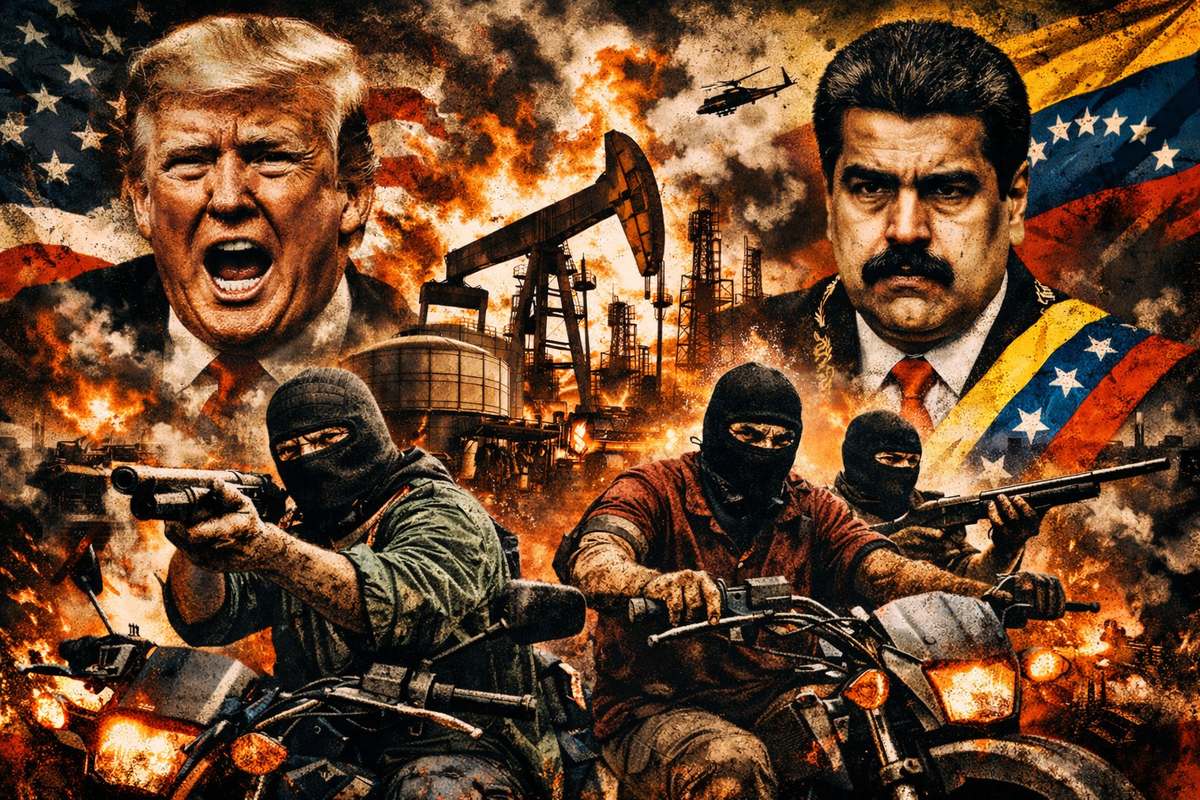
Chief among these is the Chavista government’s reliance on armed militias to assert state power, harass political opponents and repress uprisings across the capital and beyond. These colectivos (collectives) are populated by ruthless armed motorcycle gangs from Caracas’ sprawling poverty-stricken shanty towns who periodically emerge to patrol and intimidate the rest of the city whenever the government needs to call in the heavies.
I will never forget the stomach-churning image of shotgun-wielding motorcycle gangs weaving menacingly between burning tyre roadblocks. Wearing balaclavas to hide their identity, the shadowy and unpredictable colectivos inject extra fear and chaos into any street clash or volatile protest.
The Trump administration’s astonishing assertion that it will temporarily ‘run’ Venezuela raises stark questions about how exactly it will deal with the colectivos. Unless these gangs are recruited into whatever transitional governance arrangement emerges, they could spawn a ragtag armed resistance to protect their sources of weapons, funding and political patronage.
A Washington-based administration of Caracas must also contend with corrupt military officials and other heavily armed mafia-style groups that preside over lucrative narco-trafficking, illegal mining operations and other black-market enterprises that blossomed across Venezuela during Maduro’s ruinous and illegitimate presidency. Again, these figures will not simply walk away quietly if they are not ‘kept whole’ by whoever becomes the new boss.
All of this is a long way of saying that the Trump administration has probably bitten off more than it can chew, and will almost certainly look for an easy way out — if indeed there is one. Let’s explore the options.

Member discussion: Venezuela: what happens next?
Read what members are saying. Subscribe to join the conversation.