A market at war with itself
Does the mispricing thesis still hold water? Either the data is wrong, or the market is.

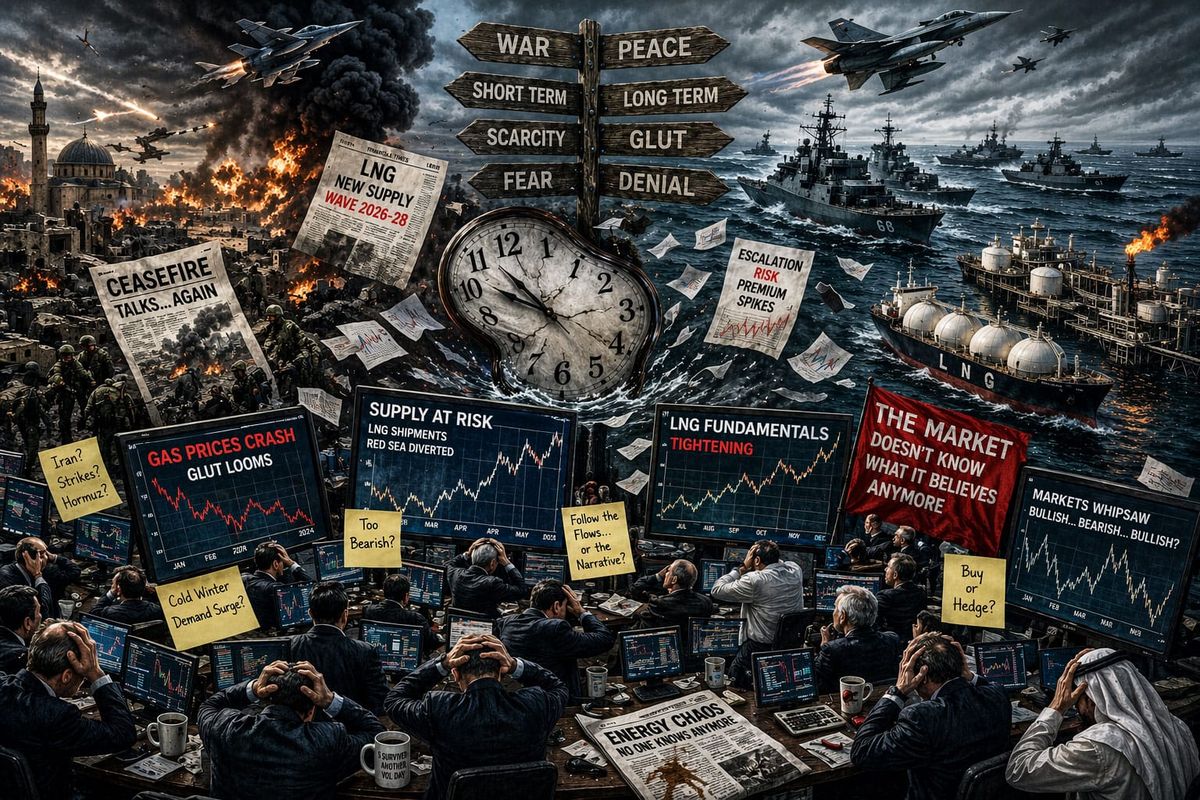
Ras Laffan partially destroyed. QatarEnergy in extended force majeure. Hormuz LNG transits doubly paralysed. The Israel-Iran-US war grinding fitfully through its second month. And front-month TTF closed Wednesday at €41.399/MWh — marginally below where it settled on 2 March, the first trading day after hostilities broke out against Tehran.
That is not a typo. The price of European gas is the same today as it was in the days after the bombs started falling. Every month Hormuz remains shut, the global LNG market loses roughly seven million tonnes of supply. Cumulative losses are deepening relentlessly towards 60 million tonnes by December. And prices are sliding sideways.
Aside from the human tragedy unfolding across the Persian Gulf, the deflation of energy commodities in the face of what was supposed to be an unprecedented supply-side shock — a dislocation that eclipses Russia’s 2022 invasion of Ukraine — is, frankly, befuddling. It challenges every reflex an analyst or trader has trained into themselves over the past four years.
So we owe it to ourselves to ask honestly: is the mispricing thesis Energy Flux has spent weeks building still intact?
The short answer: yes, but it needs examining under a brighter light. This edition of the Chart Deck — 99 slides of TTF and JKM curves, fund positioning, inter-basin spreads, netback economics, vessel tracks and proprietary model outputs — is the forum for that examination.
Prices and positions play chicken-and-egg
The last fortnight delivered a textbook unwind. Investment funds built a record 323 TWh net long in TTF futures, the fastest accumulation in the contract's history (Chart Deck slides 22–23). They have since retreated in a notable bout of profit-taking and short covering as the Trump administration veers between talk of peace and threats of annihilation, sometimes in the same breath.
The TTF Sentiment Tracker is now firmly in the bearish quadrant, even as the long-short ratio among funds remains a lopsided 3:1 (slide 33). Length is being trimmed, but the overhang is still there. The contradictions are acute.
The TTF Risk Model — a composite of the financial and physical stock-and-flow signals we track weekly — is unambiguous: bullish risk is heavily underpriced at current levels (slides 35–38). The model is not a forecast. It is a measurement of what the market is pricing relative to what the data is saying. Right now, those two things are oceans apart.
And yet prices keep drifting. So either the model is wrong, or the market is.
The loose-market narrative didn’t die. It got buried
The most honest reappraisal available is this. The structural story everyone was obsessing over at the end of 2025 — the unprecedented wave of new LNG supply scheduled to hit the water in 2026–28, and the accompanying chatter about an imminent glut — did not disappear when the first cruise missiles crossed into Iranian airspace. It was simply pushed out of frame.
Absent a confluence of diplomatic, technical and financial miracles, structurally loose conditions cannot return before 2028. That remains true. What markets may be doing now is remembering the pre-war glut thesis, after briefly trading as if it had been cancelled by the conflict.
The Energy Flux Hormuz Closure LNG Supply Impact Model (slides 97–99) anchors the other side of the argument. Assuming a 10% resumption of Hormuz flows from September 2026 and a gradual recovery to 100% by mid-2028, cumulative lost volumes are not fully offset until December 2028. Markets appear confident they will not have to wait that long. The Chart Deck shows why such confidence is, at best, a stretch — and at worst, wilfully optimistic.
The war premium is dissolving
What the deck captures in granular detail is a price complex reverting toward something resembling functionality after weeks of wartime dislocation. Oil-indexed LNG, which typically trades below spot in supply stress, is less of a bargain than it was six weeks ago. The JKM war premium is fading (slides 53–58) and the long-term/spot spread is narrowing.
The NWE–TTF basis has rebalanced to a ~$0.45/MMBtu discount (slide 46), and inter-basin arbitrage for Atlantic Basin cargoes to Asia is firmly open for the next couple of months (slides 70–73), aided by freight rates releasing from their war-driven highs (slide 45). US LNG windfall profits — the ones offtakers were banking on for a prolonged crisis — have all but vanished (slide 62); cargoes are still in the money on both sides of Suez, but the excess that characterised mid-March has gone.
The evidence of that normalisation is visible on the water. LNG Abuja diverted from France to Dahej, India, on 9 April after loading at Nigeria’s Bonny Island. Celsius Granada pulled the same manoeuvre from Gibraltar to Chittagong, Bangladesh, on 12 April after lifting from Trinidad’s Atlantic LNG project. Three cargoes stuck in the Egyptian queue behind Ain Sukhna’s FSRU have discharged and sailed ballast back across the Atlantic; a new trio waits its turn (slides 75–79). QatarEnergy, meanwhile, is positioning to lift the first cargo out of Golden Pass, sending three ballast vessels towards Texas. Project partner ExxonMobil is doing the same.
Behind the Hormuz blockade, trapped vessels are making themselves useful, lifting the odd cargo into floating storage or delivery within the Gulf. Al Kharaitiyat is ferrying cargoes from Ras Laffan to Kuwait’s Al Zour: Qatari molecules are still moving, just in much tighter, far less remunerative circles.
These are not the movements of a market bracing for catastrophe. They are the movements of a market beginning to figure out how to work around one while the messy geopolitics sorts itself out.
Demand destruction is real, and uneven
South Asia has absorbed the brunt of the price signal. With JKM near $19/MMBtu, affordability has collapsed: South Asian imports have fallen by close to 1 million tonnes year-to-date against the same period in 2025 (slide 93). China is down 1.3 million tonnes, –8% year-on-year (slide 89), as it leverages its diversified gas supply complex to enable the resale of contracted LNG volumes into a red-hot spot market.
South-East Asia, by contrast, has not taken its foot off the pedal. Imports are up 2.5 million tonnes YTD, a blistering +43% (slide 94). Europe is pulling hard too, +4.3 million tonnes (+13%, slide 88). Middle East and Africa demand is up +60% off a low base (slide 96).
The net result, captured on slide 85: the Iran war is pushing the global LNG balance from projected surplus deeper into actual shortage. Demand exceeds supply by around 1.2 million tonnes year-to-date, and on a year-on-year basis the shortfall is closer to 1.7 million tonnes. There is no glut — yet.
The Covid mirror that cuts both ways
In 2020, health policy artificially suppressed consumption. Pent-up demand, when travel constraints lifted, rebounded viciously and seeded the 2021 commodities bull run. Today’s situation is the inversion: war is artificially suppressing supply, not demand. The incentives to restore exports, particularly for Gulf states whose fiscal health rests on hydrocarbon revenue, are immense. When Hormuz reopens, Middle East LNG could rebound faster than anyone currently models.
That is the bearish edge of the analogy, and it is the one markets seem to be pricing. The bullish edge is the one they are ignoring. Covid rebounds outran forecasts because the constraint was easier to dismantle than it was to erect. Hormuz is the opposite: held shut by an unpredictable White House out of its depth, and a bombed-out Tehran clinging onto its only source of leverage for dear life.
A Covid-style rebound is a defensible bet. But it requires a Covid-style reopening path, and nothing visible right now resembles one. It depends on an awful lot going right, reasonably soon.
Personally, I do not see a swift resolution as the base case. The yawning political gap between Tehran and Washington has not narrowed. The physical damage to Ras Laffan is not theoretical. The force majeure remains in force. And the data shows, unambiguously, that risk is mispriced.
But the uncertainty is vast, and observers must remain alive to the possibility of another narrative whiplash from famine to feast — accelerated, perhaps, by demand destruction running deeper across Asia than the aggregate numbers currently suggest.
Storage season begins. So do the hard questions
EU gas injection season is finally under way, at a rate marginally above the seasonal average (slides 48–51). Ursula von der Leyen’s recent refill coordination guidance is an overdue step in the right direction that could frame the refilling effort. But with seasonal spreads flat to inverted (slide 16), a live question sits over the injection curve: how long can this pace be sustained, and should the EU be targeting maximum storage in these price conditions at all? Will the Commission tell member states to subsidise uneconomic injections? If so, it will be rapidly priced in by TTF traders, just like in January 2025 when Germany floated (and then rapidly abandoned) an unworkable storage subsidy scheme.
The Chart Deck does not answer these questions. What it does is lay out the inputs — storage deviation versus seasonal norms, weekly injection rates, the Spark Signals complex, the LNG Physical Balance Index, the Storage-Speculation regression modelling — that any serious answer has to engage with.
What’s inside the Chart Deck?
Ninety-nine slides. Every major gas and LNG benchmark, in history and in futures.
The full TTF Sentiment Tracker and TTF Risk Model outputs, all in one place. The Storage-Speculation Nexus, illuminating fund positioning along the TTF curve.
Granular US LNG netback breakdowns by delivery month and route (Sabine to Japan, Dec-24 through Jan-27). Global flows by region. Vessel-level reporting on the cargoes capturing the Atlantic-Pacific arbitrage right now.
And the Hormuz Closure LNG Supply Impact Model: the framework quantifying what has actually been lost, and how long replacement will take.
Energy Flux subscribers on the Premium and Chart Deck tiers get the full deck. Everyone else gets this note.
If you rely on conviction-led analysis that takes a position, defends it with data, and revises it in daylight when the data demands — the Chart Deck is where that happens.
👇 DOWNLOAD: 99 slides in .ppsx and .pdf format 👇

Member discussion: A market at war with itself
Read what members are saying. Subscribe to join the conversation.