
Japan’s LNG love story is not over yet
Rising power demand, slow nuclear restarts and 10 GW of auction-backed gas plants could halt the fall in Japan’s LNG imports, argues Japan NRG.

There is a neat and persuasive story about Japanese LNG demand. It goes like this: the country panicked after Fukushima, shut its nuclear reactors, bought enormous quantities of gas to keep the lights on, and has been slowly unwinding that emergency ever since. Nuclear plants are returning, solar panels keep multiplying, batteries are finally arriving at scale and Japan’s population continues to shrink. Draw a line through LNG imports since their post-Fukushima peak and it points reassuringly down and to the right.
The story may even turn out to be correct. But we should probably resist writing Japan’s obituary just yet.
There is a plausible alternative in which Japanese LNG consumption stops declining, and could even rise again for a period. The case does not rest solely on the now-obligatory promise of voracious AI data centres. It is also being built into the plumbing of Japan’s electricity system: slower nuclear restarts, rising power demand, increasingly violent swings in renewable output, transmission constraints, new gas-fired generating capacity and a growing need for fuel that can be summoned during particular hours and seasons rather than burned evenly throughout the year.
So, you’re telling me there’s a chance? Mitsubishi Corp certainly seems to think so.
In September, Japan’s largest trading house joined Shell and others in approving the second phase of LNG Canada, doubling the project’s capacity from 14 million tonnes per year to 28 million. Mitsubishi expects to spend about ¥500 billion ($3.1 billion) on its share of the expansion and, from the early 2030s, increase its own offtake from 2.1 Mtpa to 4.2 Mtpa. The additional Mitsubishi volumes are expected to be marketed mainly into Japan.
That is a fairly substantial wager for a country supposedly approaching the twilight of its LNG age. It is not the only one.

The bear case is hard to dismiss
Japan imported roughly 66 million tonnes of LNG in 2024, far below the volumes reached after the Fukushima disaster forced most of the nuclear fleet offline. That decline is easy to project forward: drawing on the targets in Japan’s sixth Strategic Energy Plan, IEEFA forecast in 2024 that demand would fall to about 50 Mt by 2030. More recently, Energy Flux projected a 2030 range of 45.3–64.7 Mt.
Our pre-Hormuz-crisis Japan NRG scenarios are substantially higher, at 68.5 Mt in the base case and 67.4 Mt even in the lower case, and all assume nationwide power demand will resume growing.
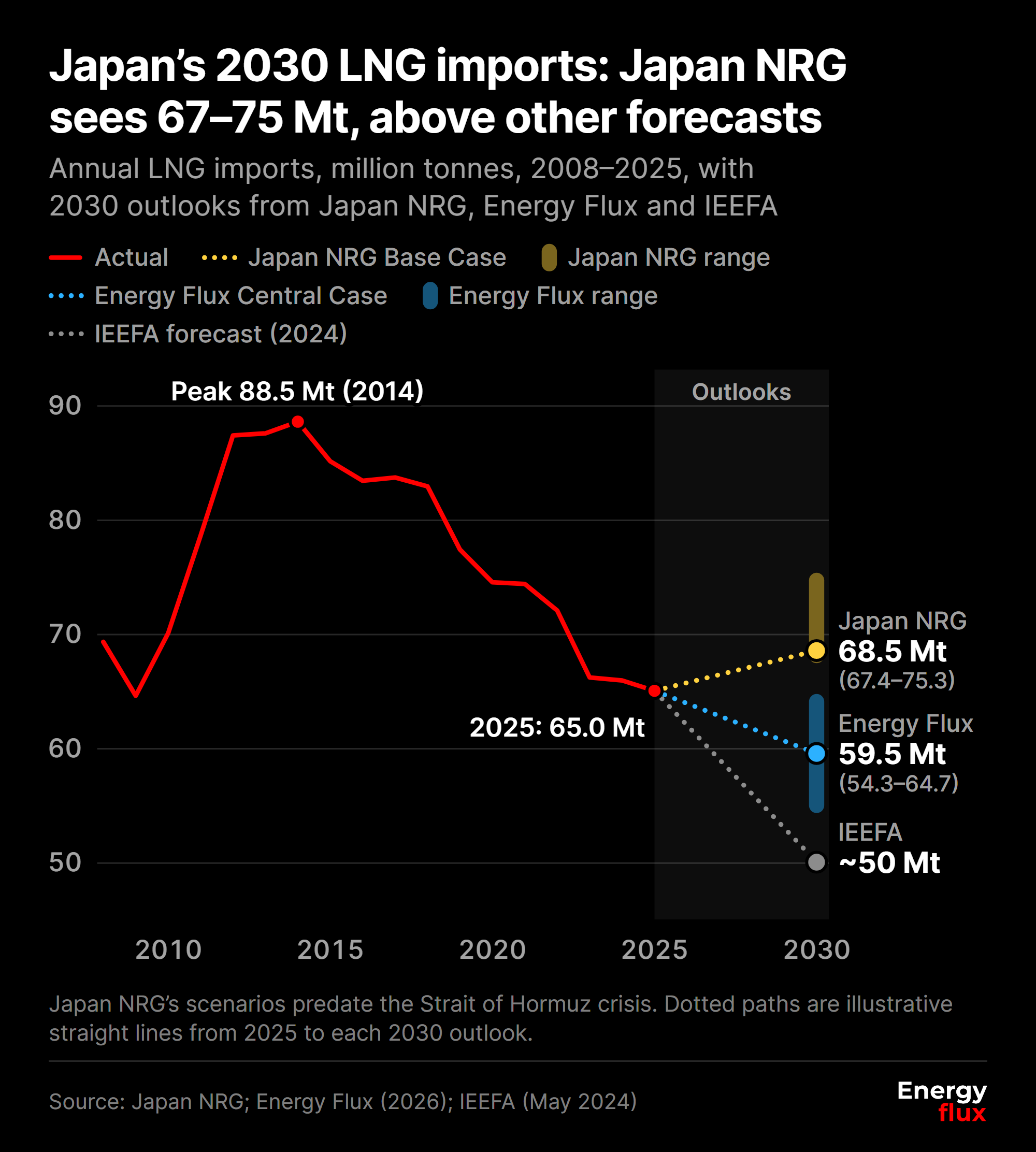
The downward case is compelling. Japan has a statutory commitment to carbon neutrality by 2050. Solar already supplies close to 10% of electricity and the latest energy plan seeks to lift renewables from 22.9% of generation in FY2023 to 40–50% by FY2040. Nuclear is targeted at around 20%. Thermal generation, which still accounted for 68.6% in FY2023, is supposed to fall to only 30–40%. (Although, how that “thermal” moniker splits between gas and coal is undefined). And nuclear restarts have also continued, however slowly.
Add continued efficiency gains, a smaller population, a bustling battery storage sector and steadily expanding renewable capacity and it is not difficult to arrive at the conventional conclusion: every reactor restart and every new solar farm takes another bite out of the LNG requirement.
Except, the arithmetic of Japan’s future power system is becoming less straightforward.
The straight-line story of decline is built on annual totals. The rest of this Deep Dive looks at the hours, seasons and contracts where Japan’s need for gas actually shows up. It explores:
- The flexibility premium: Why Tokyo’s LNG plants are ramping output at gigawatt-scale in sunny days in March
- The nuclear misconception: Why faster reactor restarts don’t remove the need for flexible gas
- The auctions carve-out: How an auction for decarbonised power ended up awarding more capacity to LNG than to any other source
- The supply signal: Japan’s largest LNG buyer signed a multi-decade contract and is sourcing winter-only cargoes – can this really all be for trading and resale?
- All of the above: How Kyushu is building new gas plants despite hosting Japan’s greatest concentration of solar and a large nuclear fleet
💥 Article stats: 3,000 words, 14-min reading time, 5 charts
Need access?

Member discussion: Japan’s LNG love story is not over yet
Read what members are saying. Subscribe to join the conversation.