Europe rolls the dice on winter gas
Our new interactive data model reveals how bad things could get in the EU gas market this winter, and what must go right to avoid disaster


The European natural gas market is trading at the €70 per megawatt-hour mark for the first time since January 2023 on the belated realisation that global LNG supplies will be constrained by the Hormuz crisis throughout most of winter. The exact trigger was Italian utility Edison confirming that QatarEnergy has extended its force majeure notice to November, which should come as a surprise to precisely nobody who has been paying attention to the situation in the Middle East.
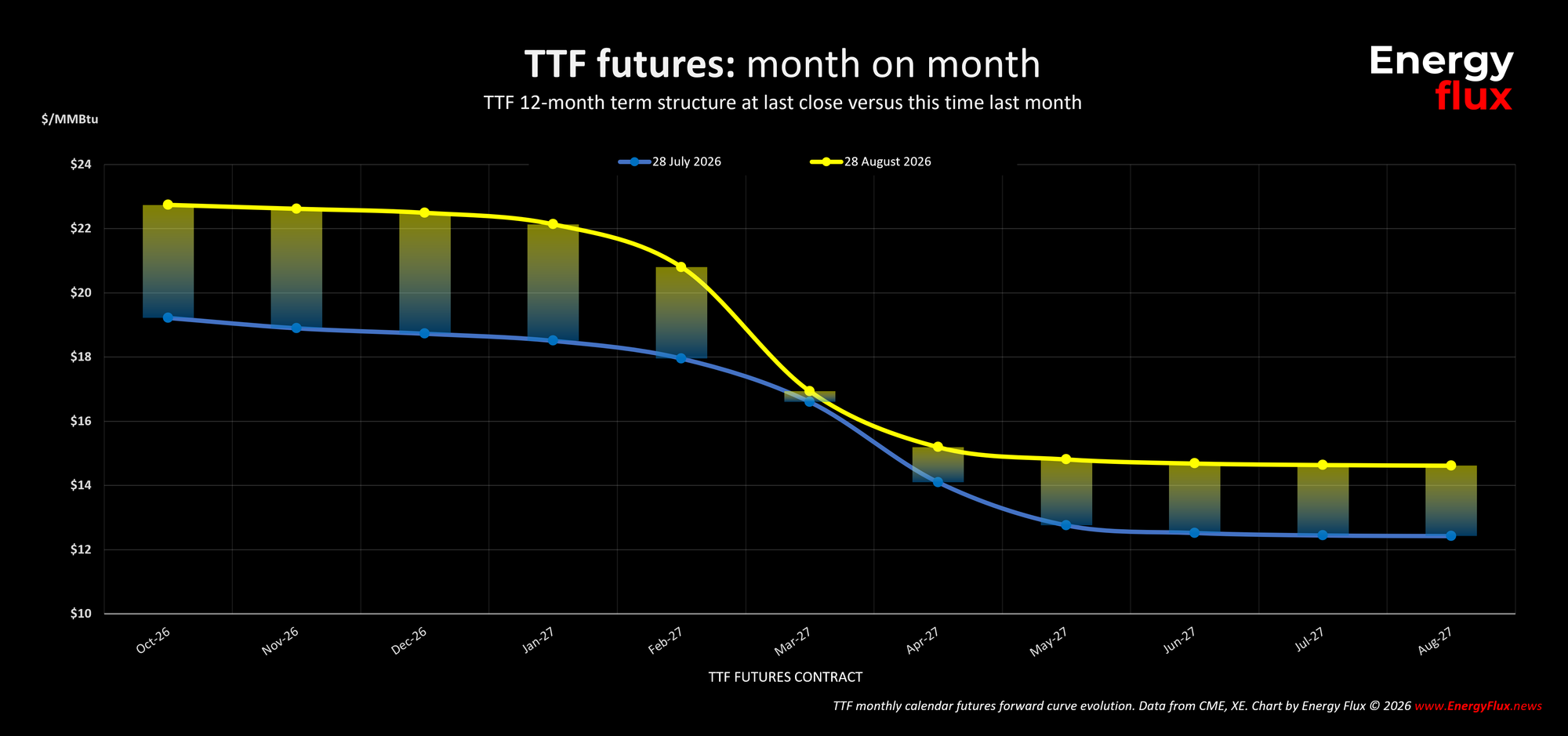
Markets spent the summer trying and mostly failing to price the prolonged-Hormuz scenario. Last week the dam finally broke. The move to €70/MWh was not confined to front-month Dutch TTF, the EU’s benchmark contract: the entire winter strip repriced upwards by roughly 15% over the last month, and now sits at €50–67/MWh from October through March. Winter risk is finally showing up where it belongs: in the winter curve.
If anything, the surprise is that it took this long. Regular readers will be familiar with the Energy Flux position on the intractability of the Hormuz crisis, and on the blasé confidence of markets that priced a rapid restart of Qatari LNG exports despite the evident logistical obstacles. Those Qatari chickens are now coming home to roost in half-empty European storage caverns.
‘Too optimistic’: Berlin baulks
Germany has now conceded the point. “We were too optimistic,” Sebastian Kemper, managing director of market manager Trading Hub Europe, told Bloomberg last week. In May, THE had assumed Hormuz would reopen “shortly” and that storage economics would fix themselves. THE stands ready to buy gas for the state, but Berlin has not asked it to. Kemper now expects German storage “around 70% full before winter, or perhaps a little bit less.”
Even that hedged number requires heroics. German sites stood at 53.0% full (130.7 TWh) on 30 August. Reaching 70% by the start of the heating season means injecting roughly 42 TWh in nine weeks, more than Germany has ever added from this point (the biggest such build was 39.4 TWh, in 2018, according to Gas Infrastructure Europe data). Repeating the historical average build instead lands Germany at about 59% on 1 October; matching the best-ever September gets to 62.5%. Whatever intervention now emerges will be too little, months too late.
The continental picture is the same problem at scale. EU storage stood at 65.1% on 30 August. Project forward every August-to-October refill sprint of the last twelve years and the range for 1 October runs from 67.6% to 74.3%, with the central case at 71.1%. Even if the next four weeks match the strongest late-season build on record, Europe opens the heating season at 74.3%, a whisker above the lowest opening ever recorded (74.0% in 2021, the year that incubated the gas crisis). Filling to 80% before withdrawals begin is out of reach, never mind 90%.
So, how bad could it get?
That is the question everyone is now asking, and the answers on offer are impossible to compare: every desk carries different assumptions, most of them undisclosed. There is no common barometer. So instead of lamenting that fact, we built one: the EU Gas Winter Stress Tester, 2026-27 edition, an interactive data model, live now on the website for logged-in subscribers.
The concept is simple. You set the conditions: winter severity, LNG inflows, industrial demand, Russian LNG ban compliance, wind, hydro, French nuclear, the opening storage level. The model plots the storage depletion path those conditions imply, and prints an estimate of how much more supply (or less demand) Europe’s gas market would need to keep storage levels within the seasonal range.
It also reports the TTF price band most closely associated with the degree of storage tightness implied by the user’s input conditions. Every output is based on 2014–2026 gas market data, and the model comes pre-loaded with three scenarios: Manageable, Tight, and Crisis.
The headline finding is that Europe enters this winter with the deck stacked against a ‘Manageable’ outcome. For storage to end March inside historical norms, essentially everything has to go right at once. If conditions simply stay as they are, the tanks end the winter well below the all-time low. The risk distribution is asymmetric, and not in Europe’s favour. The model quantifies exactly how far each factor moves the needle.
So, how cold does it have to get before storage depletion enters uncharted territory? How much winter gas hangs on the Russian LNG ban, and what would full compliance do to storage depletion rates? Which dials genuinely move end-March storage, and which are rounding errors? What does history tell us about how TTF responds to differing storage levels? And what about French nuclear availability?
All of these questions are answered below, and in the model itself.

The full analysis continues below: three modelled winters, the supply deficit they each imply, and the dials that genuinely move Europe’s gas balance. Paid subscribers also get the interactive Stress Tester, plus every other data model, Deep Dive and Chart Deck in the archive. Why not join them?

Member discussion: Europe rolls the dice on winter gas
Read what members are saying. Subscribe to join the conversation.