Canadian LNG: the maple-leafed mirage
EU leaders worry about growing dependence on US LNG, and Canada offers an alternative. But European utilities buying Canadian LNG will likely send it to Asia while US gas supplies Europe. That arrangement has value, but needs an honest political sales pitch.

Canadian and European leaders meet in Montreal on 29 and 30 October for the EU-Canada summit, which seeks to launch a ‘new, transformative alliance’ as a counterweight to openly hostile US trade policy. Among the deliverables is a feasibility study on Canadian LNG exports to Europe, according to reports.
The energy centrepiece is Ksi Lisims, a proposed 12 million tonne per annum floating liquefaction project in British Columbia, developed by Western LNG, whose backers include Blackstone and TotalEnergies, with the Nisga’a Nation and a group of upstream producers known as Rockies LNG.
Nine of the project’s 12 mtpa of capacity are already pre-sold or earmarked, mostly for European oil majors and utilities. Uniper and SEFE of Germany have signed deals of up to 20 years; Uniper expects first deliveries from 2032, and SEFE’s are due “by the early 2030s”.
European buyers ≠ European deliveries
The contracts give buyers more freedom than the political framing suggests. All six buyers, including Centrica, SEFE and Uniper, have signed up on a free-on-board (FOB) basis: they take ownership at the export jetty, charter their own ships and choose where the cargoes go.
For a Pacific-coast plant, Asia is the obvious destination. European buyers can sell Canadian cargoes there and buy or swap US Gulf Coast cargoes to meet their commitments at home. This portfolio optimisation is both economically rational and the most likely outcome under the economics examined here, whether the politicians jetting off to Montreal acknowledge it or not.
Europe can benefit. More Canadian supply in Asia can reduce competition for Atlantic cargoes, while flexible portfolios give buyers more options. But a politically-brokered energy security arrangement that still brings US LNG into Europe is not the same as one that sees some of it replaced by Canadian cargoes.
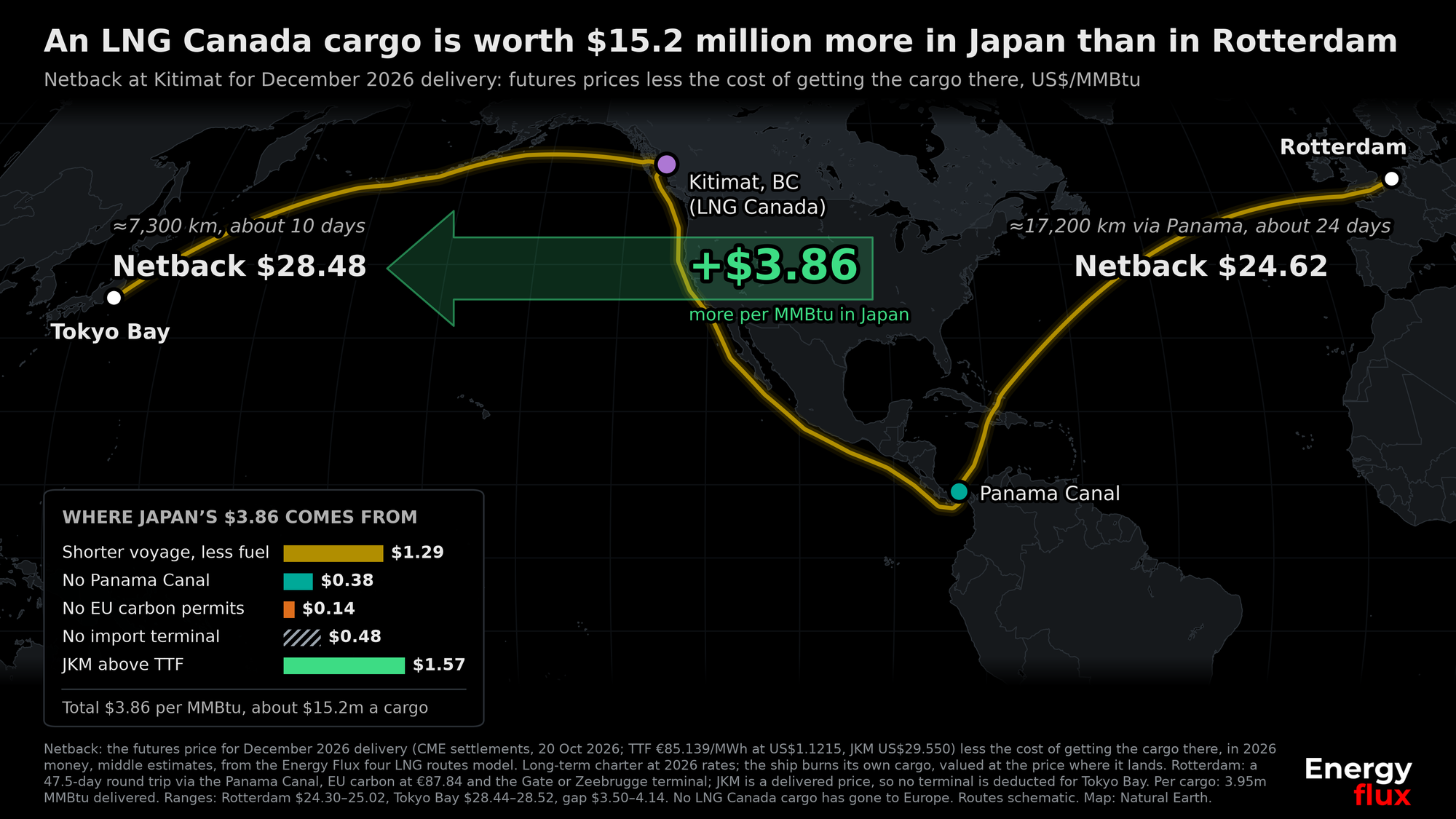
Today’s prices show the incentive. At futures prices for December 2026 delivery (as of 20 October), an LNG Canada cargo loaded at Kitimat nets back $28.48 per MMBtu if sold in Japan, against $24.62 in Rotterdam. That is $3.86 more, or about $15.2 million per 174,000 m³ cargo. The netback is the selling price less the cost of getting the cargo to market.
Canadian LNG can therefore help Europe only indirectly. The harder question is whether direct European deliveries make commercial sense, and what governments would have to pay to secure them.
Below, Energy Flux explores the economics of sending LNG from both the western and eastern coast of Canada to Europe. It then stress-tests Ksi Lisims against the early-2030s gas market it will be selling into, and quantifies what it would take for Canadian LNG to flow directly to Europe in two crisis scenarios:
- A prolonged EU-Asia gas price dislocation that supports a TTF premium over JKM large enough to offset the longer shipping costs
- A European taxpayer-funded initiative to secure all available Canadian LNG supply throughout one winter
The Deep Dive also examines a proposed workaround that involves piping US shale gas over the Canadian border to Saint John.
Interactive data models
Premium subscribers can read the full analysis, which is based on the outputs from two new Canadian LNG interactive data models. These models underpin the Deep Dive conclusions, and are fully interactive, allowing users to test their own assumptions and economic configurations.
- The Four Routes interactive model explores Canadian LNG economics from the east and west coasts, versus US Gulf Coast LNG and the arbitrage opportunity in Asia.
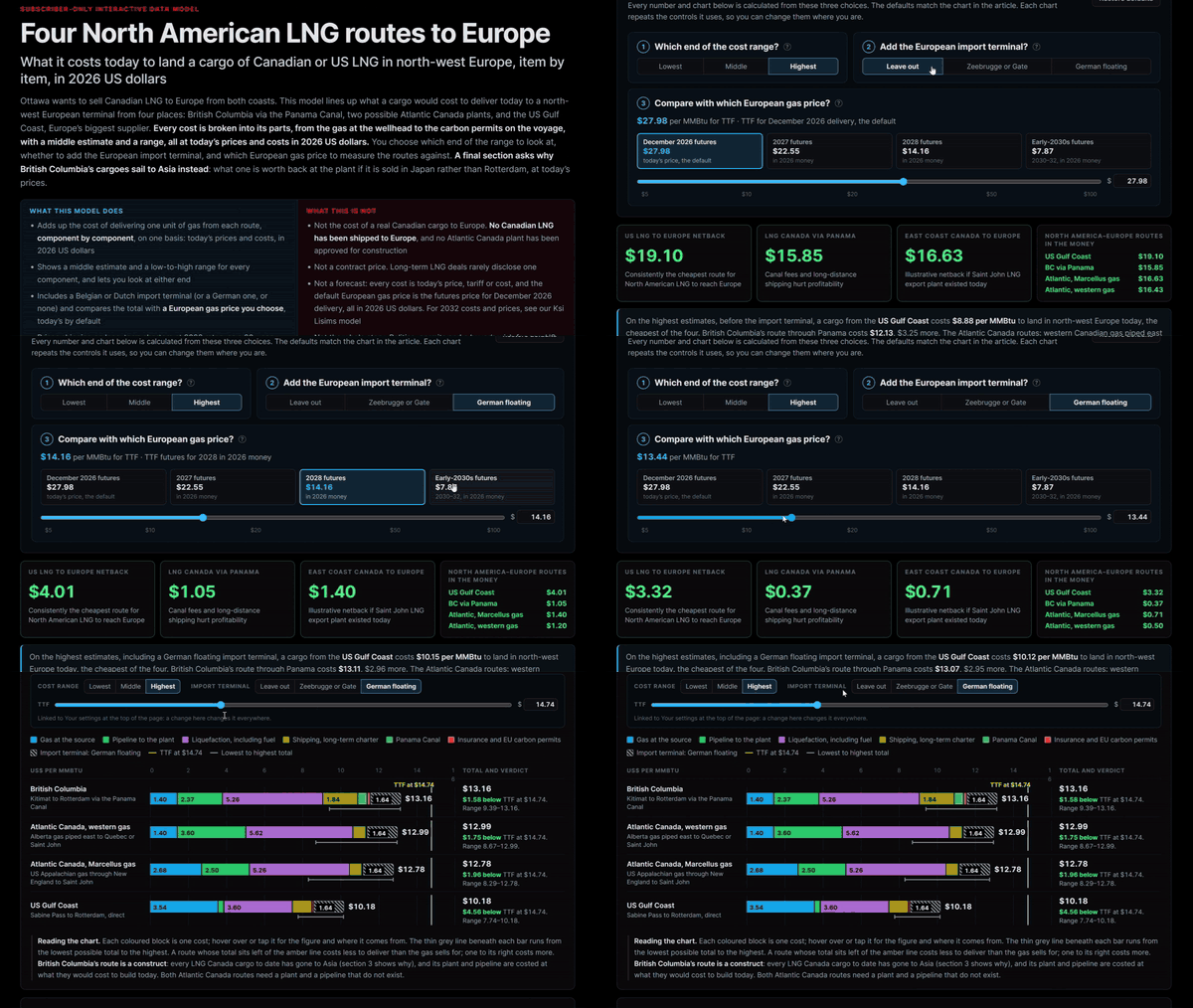
- The Ksi Lisims interactive model drills down into project-level data to understand the economic assumptions behind Canada’s burgeoning LNG partnership with Europe.
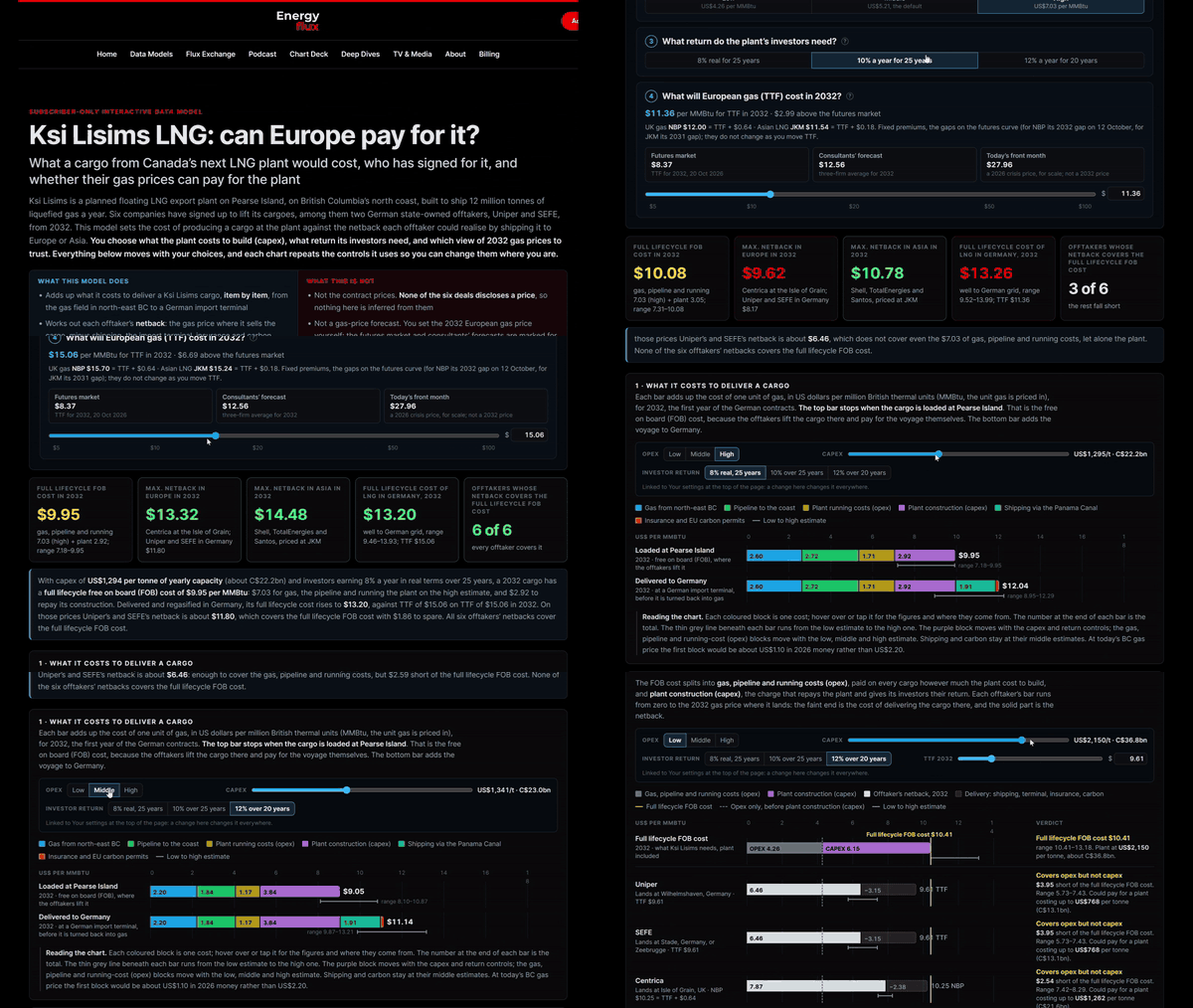
💥 Article stats: 3,500 words (14-min reading time), 7 charts and maps, 2 interactive data models

Canada’s pitch to supply Europe with LNG looks different once every cost is counted: we price both coasts leg by leg, and test whether Ksi Lisims can cover its full lifecycle costs at 2032 gas prices.
Upgrade to Premium to read the full analysis and test your own assumptions in two new interactive data models.

Member discussion: Canadian LNG: the maple-leafed mirage
Read what members are saying. Subscribe to join the conversation.