America’s accidental heist of the global LNG business
GASTECH 2026 REFLECTIONS: War shifts US strategy from hard sell to soft power, while Qatar goes on the defensive


What a difference a year makes. Or should that be, what a difference a war makes.
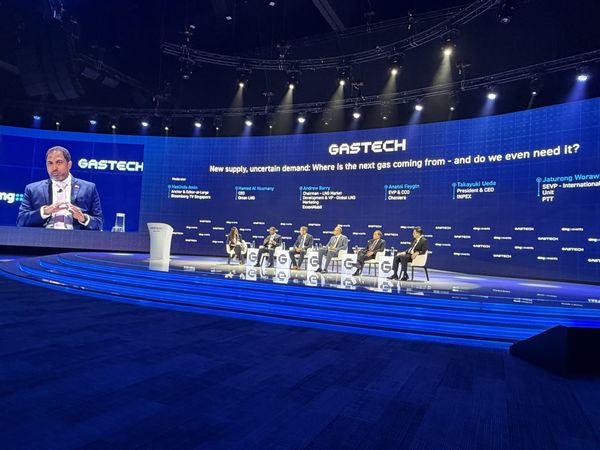
Gastech 2026 in Bangkok felt quite distinct to the America-dominated LNG hard-sell extravaganza that was Gastech 2025 in Milan. This year the event had a more muted business-as-usual vibe thanks to tectonic shifts unfolding in the Middle East.
The glitzy Gastech event is still the gas industry’s biggest party (and boy, what a party it was). But this time the only people in the mood to celebrate were the sellers. Or more precisely, those selling LNG sourced from outside the Persian Gulf.
Prolonged closure of Hormuz has given a shot in the arm to the US LNG industry, its financiers, offtakers and portfolio players. Prior to March 2026 a structurally lower gas pricing regime was looming, threatening to squeeze margins and throttle investment in new liquefaction projects into the 2030s.
The more-than doubling in European wholesale gas prices since the US-Israel offensive has dispelled those fears for at least another year or two. The Hormuz crisis juiced transatlantic margins and rained windfall profits down on anyone with flexible non-Hormuz LNG optionality on their books.
Buyer’s market postponed, again
This is all old news, but it has taken a while for LNG buyers to internalise the structural realignment precipitated by the Iran war and unrest reverberating across the Middle East.
Beleaguered buyers stung by the sudden loss of Qatari volumes have endured soaring spot prices while holding out for relief, guided by the LNG industry’s own promise (repeated countless times at Gastech) that the Hormuz crisis will be a momentary blip.
The dawning realisation that Hormuz might never fully reopen has driven buyers to seek alternative supply routes. Diversification was the buzzword in Bangkok, and the deals sheet reads as a collective vote to buy LNG from anywhere but the Persian Gulf.
Notable LNG deals signed at Gastech 2026
- Brazil’s Petrobras took its first US term supply, a 20-year sale and purchase agreement (SPA) from Sempra’s Port Arthur Phase 2
- China Gas added supply from Venture Global’s Louisiana portfolio, notable less for its size than for restarting US-China LNG contracting after last year’s trade-war freeze ahead of this week’s Trump-Xi summit in Washington
- South Korean steelmaker POSCO signed a 10-year heads of agreement with Australia’s Santos, and Santos in turn lined up 1 mtpa for 20 years from Canada’s Ksi Lisims, explicitly to add a non-Australian leg to its Asian supply
- Gastech host PTT, Thailand’s state energy major, signed three deals including a long-term purchase from Equinor and resale to Korea’s GS Energy Trading, framing them as broadening its procurement
- TotalEnergies signed a long-term SPA to supply portfolio LNG to GS Energy in South Korea
- Glencore signed a 10-year supply deal with a subsidiary of China Suntien Green Energy, to be sourced from its global portfolio
The idea is that spreading import dependence across diverse outlets and contractual tenors will shield buyers from who knows how many more years of geopolitically-fuelled energy market volatility. That is the hope, at least.
From hard sell to soft power
Last year’s Gastech event was characterised by the overwhelming political firepower of the high-ranking US delegation. Not one but two Trump cabinet secretaries (DoE’s Chris Wright and DoI’s Doug Burgum) took to the stage to deliver a double-barrelled barrage of MAGA alternative energy facts that left the assembled press pack dumbfounded.
My takeaway back then was that the US LNG industry saw the writing on the wall and wheeled out the big guns. Evidently in late 2025 they felt the need to hard-sell their product to a reluctant European crowd unconvinced of the benefits of long-term contracts on the cusp of a long-awaited new era of global LNG oversupply.
With Hormuz closed, the US no longer faces the same sales challenge. This year, the US presence was less about force-feeding the LNG narrative at muzzle velocity, and more focussed on the slow-burn technocratic nitty-gritty of prizing open new markets.
How is America turning wartime disruption into long-term LNG business? Subscribe to read my reporting from Bangkok on the quiet diplomacy behind the deals, Qatar’s shrinking options, and the demand problem that could spoil the party.
Upgrade to Premium for the full Gastech 2026 write-up 👇

Member discussion: America’s accidental heist of the global LNG business
Read what members are saying. Subscribe to join the conversation.