Quantifying the AI data centre backlash, in Bcf/d
American voters turned on data centres at the midterms. Our new interactive model quantifies the impact of a grassroots rebellion on AI gas demand, and lets you run the numbers yourself

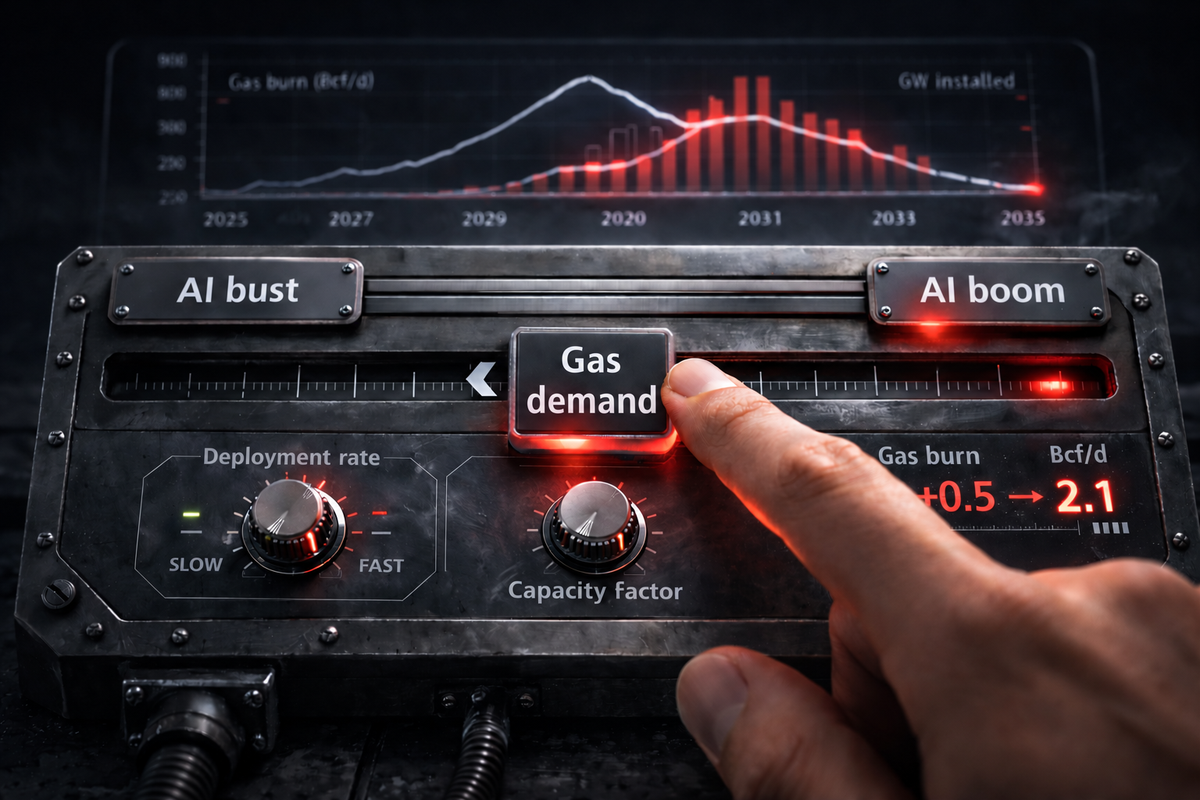
Monday’s Deep Dive left a question hanging. If the American grassroots revolt against data centres spreads beyond the ballot box, how much of the AI boom’s gas demand does it take with it? Today we put numbers on it, and hand you the controls.
The AI Gas Burn Constraint Model is an enhanced version of the model we first published in February. It runs on fresh inputs, and it is no longer an Excel download: it is an interactive model that runs in your browser. It joins our new line of interactive data models for Premium subscribers.
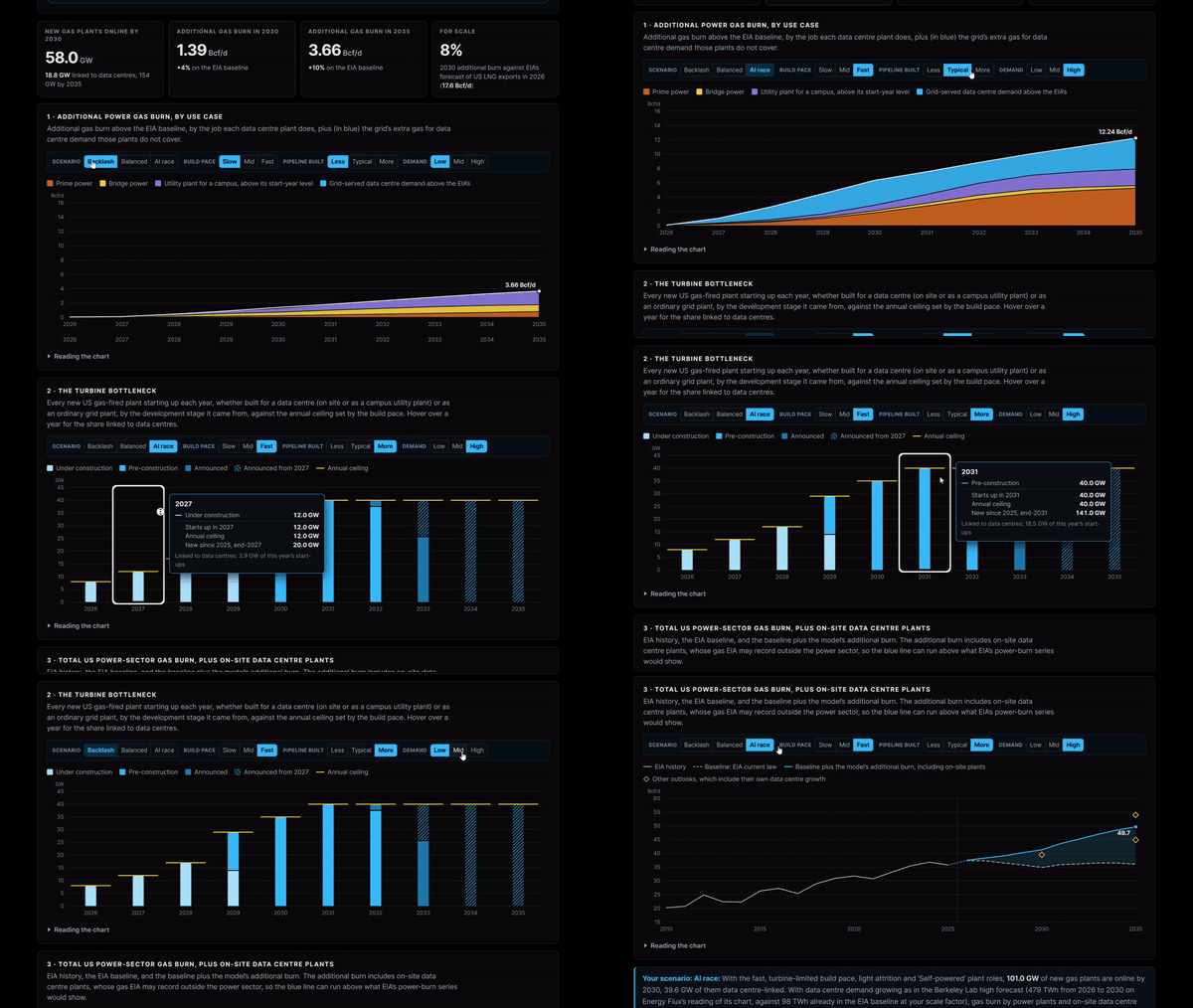
The constraint model starts from the 378 GW of gas plants in development across the United States, of which half are planned to power data centres directly (per Global Energy Monitor). It then runs that pipeline through the limits that decide how much actually gets built: bottlenecks in turbine supply, permitting, and project attrition.
It also splits data centre plants between grid-connected utility plants and on-site generation, and the on-site plants by the job they do: running day and night as the facility’s main power supply, standing by as backup, or serving as a bridge until the grid connection turns up.
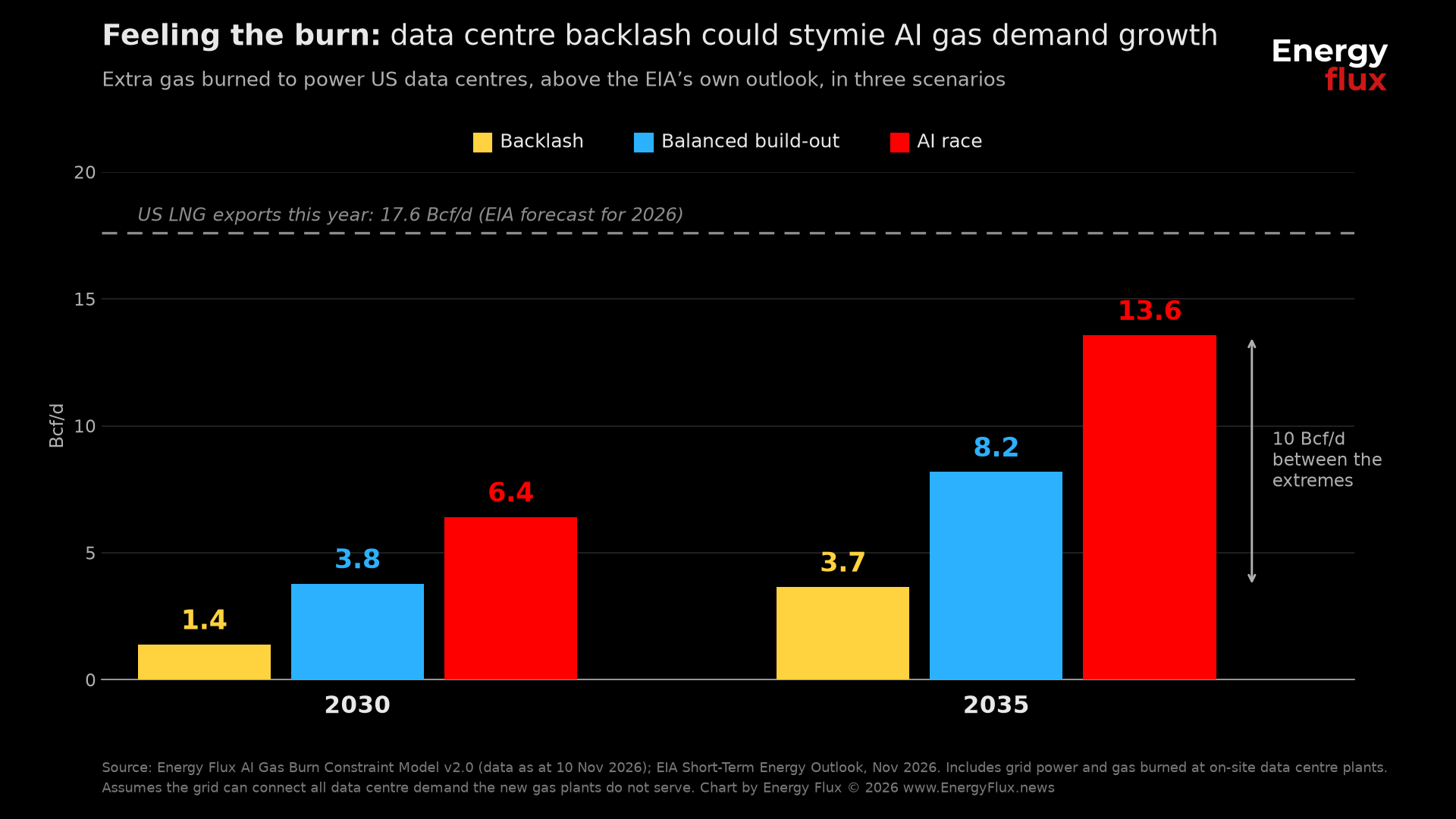
The model comes pre-loaded with three scenarios – Backlash, Balanced build-out, and AI race. Gas consumption varies wildly between them:
- Backlash. Permit fights and turbine queues slow the build, and data centre demand grows at the IEA’s slower pace. Extra AI data centre gas burn = 1.4 Bcf/d by 2030 and 3.7 Bcf/d by 2035.
- Balanced build-out. Turbine supply grows in line with expansion plans of the turbine makers (OEMs), and data centre demand follows Berkeley Lab’s reference case. Extra gas burn = 3.8 Bcf/d by 2030 (more than a fifth of this year’s US LNG exports), and 8.2 Bcf/d by 2035.
- AI race. Hyperscalers achieve maximum buildout in a mad dash to ‘beat China’ and dominate frontier model development = 6.4 Bcf/d by 2030 and 13.6 Bcf/d by 2035.
The wide range illustrates what is at stake. By 2035 the gap between a popular backlash and an all-out AI race is about 10 Bcf/d of extra gas burn, more than half of the amount of gas that Gulf Coast LNG plants are liquefying and exporting today.
Even against the Balanced case, a backlash that succeeds in its aims of thwarting data centre development would take about 4.5 Bcf/d off the 2035 figure. That moves the needle more than any choice about turbines, gas engines, or how data centres and gas plants are utilised. This is because the sorts of restrictions that won broad voter approval on 3 November would directly impact how much power data centres use.
The scenarios can be fine-tuned by adjusting the many assumptions underpinning them. These technical parameters cover project lead times, how much of the overall US gas power plant pipeline will serve data centres, gas turbine heat rates by utilisation role, and many more.
See for yourself: explore our three scenarios for AI data centres, and how far each variable moves gas consumption in 2030 and 2035.
Jumping the OEM queue
The bottleneck on gas-fired generators is very real. A story about Anthropic, the AI lab that built Claude, flew largely under the radar this week.
According to the Financial Times, Anthropic took over an order for about 1.7 GW of Caterpillar gas generators in September. The order was placed two years earlier by a San Antonio developer, OnePWR, but the deal was never closed. The reported price was about $3.4bn.
If AI labs are taking over other buyers’ multi-billion-dollar orders to jump the queue, that tells you how fierce the competition for generators has become.
This approach might secure power sooner for Anthropic. But it does not make the OEM factories churn out more generators: a slot one buyer takes is a slot another buyer loses.
Run it through our constraint model and the lesson is the same as at the ballot box: who owns the generators matters less than how much electricity data centres end up using. Gas burn follows demand, and voters are trying to give politicians a popular mandate to throttle data centre development.
Whether they act on it remains to be seen. If they do, the results have already been modelled.
Seb Kennedy | Energy Flux | 11 November 2026
 Seb Kennedy

Member discussion: Quantifying the AI data centre backlash, in Bcf/d
Read what members are saying. Subscribe to join the conversation.