Lame duck, locked and loaded
Eight weeks before Democrats take Congress, Trump has nothing left to lose. The fragile recovery in Hormuz LNG transits hangs in the balance, alongside so much else.

Paid subscribers:
Download this week’s Chart Deck
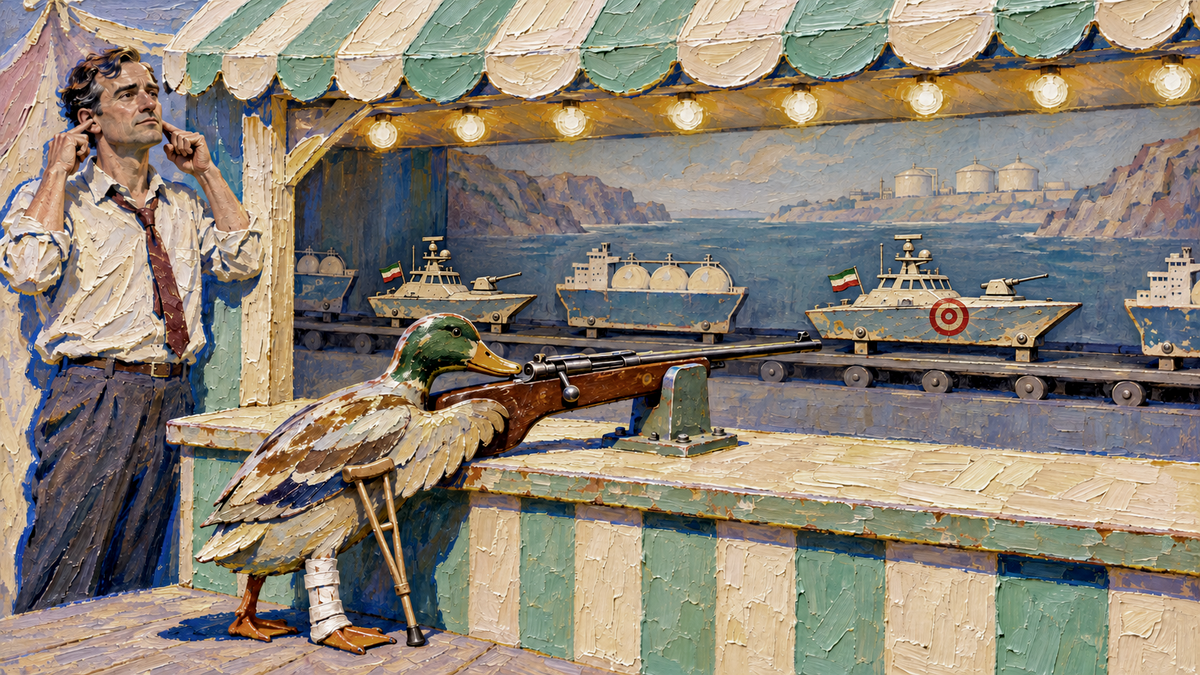
On Tuesday, American voters handed Congress to the Democrats in what Ted Cruz called “a blue tsunami”. On Wednesday, the vice president blamed the war. On Thursday, the president said the US was “locked and loaded” if needed: “You will know soon enough.” Good luck pricing that.
Pre-midterms, there was widespread expectation of the gloves coming off: Trump ordering US strikes on Iran, liberated from public opinion. That expectation, and fresh attacks on Gulf shipping, pushed front-month Brent to $117.64 a barrel on 30 October, its highest settlement since April, and TTF briefly above €100/MWh for the first time since December 2022.
Post-midterms, he is like a cornered animal. There is a school of thought that more kinetic action is likely since he has nothing left to lose. But on the eve of the vote he told NBC “no” when asked about new strikes (hours before US forces struck Qeshm Island), and on election night he told the FT there were no immediate plans. Everyone is left guessing. Most likely? Stalemate, because even a return to full-scale bombing is not guaranteed to achieve regime change. But there are very different routes to get there.
Stick, twist, or deal?
Trump has no easy options. The war is wildly unpopular: 65% of Americans disapprove of his handling of it. And while the incentive to hold back ahead of the midterms might have eased, the president now faces relentless pressure from a Democratic-controlled Congress from January, and a Republican party incandescent at losing control of the legislative branch for the last two years of his term.
The largest group in an ICIS poll of traders expects Trump to escalate; ICIS’s own director of energy told Bloomberg a deal is likelier. Eurasia Group puts renewed US strikes at 60%, a continued standoff at 30%, and a deal at 10%.
The only certainty is that Congress changes hands on 3 January. Democrats will control both chambers until January 2029, but without a veto-proof majority. Beyond that, there is intense disagreement about what happens next because the president is out of palatable options:
- Twist: a full-scale resumption of US strikes in the lame-duck window. Two carrier groups are already in the region, US officials told CBS. Expectations of exactly that, plus fresh attacks on Gulf shipping, were being priced a week ago, when TTF settled at €103.94; Eurasia reckons any escalation could push Brent to $110–125.
- Stick: stalemate, with a squeeze. The first purse-string test comes before Democrats even take over: federal funding runs out on 11 December, spending bills need 60 Senate votes, and the Pentagon wants another $67bn for the war. None of it grants Dems the power to end all hostilities while Trump holds the veto, but it is a slow puncture for the TTF risk premium.
- Deal: Iran has sent Washington a nuclear proposal via Qatar, a senior Iranian official told Reuters on Thursday. But its security chief, Mohsen Rezaei, says Iran will neither open Hormuz nor negotiate until its reported seven conditions are met. That is the bearish path for TTF and JKM, though Qatari LNG would not snap back: QatarEnergy’s chief says undamaged trains could restart within a week of a deal, if ships are available, but two of Ras Laffan’s 14, hit in March, need about three years of repairs.
Paid subscribers:
Download this week’s Chart Deck
Friendly fire in Hormuz
Against that opaque political backdrop, an Iranian lawmaker says Iran has exempted Indian, Chinese, Iraqi and Qatari vessels from its Hormuz transit restrictions. Anadolu Agency ran the news on Tuesday night, about two hours after a Tehran student news agency posted video of Amir Hayat-Moghaddam, deputy chair of parliament’s national security committee, saying it at a meeting.
If true and it holds, this could be the most significant development towards reopening since the war began. But that is a very big ‘if’.
Every version of this story rests on Moghaddam’s remarks alone, and no Iranian authority has confirmed it. Nor is the idea new: in March, Tehran said ships from ‘friendly’ nations, India and China among them, could pass.
At this stage, we have no way of knowing whether this sort of statement is made in good faith, bad faith, or is devoid of faith altogether. His explanation is transactional: India’s exemption lets Iran import medicine, China’s buys political support. “We are doing deals,” he told the meeting. Quite.
But it doesn’t all add up. Iran says Qatari vessels will be able “to pass without charges” per Anadolu, which begs the question: why? Are the Iranians compensating for destroying two of Qatar’s liquefaction trains back in March and throttling Qatari war revenues? If so, why did Iran’s own strait authority nearly double its ‘non-compliant’ blacklist to 240 ships, with Nakilat and QatarEnergy vessels among them, the day before Moghaddam spoke?
Forget the words being said. The most reliable test is the ships.
Our analysis of Kpler’s vessel-tracking data shows laden LNG carriers leaving the Gulf rising from almost zero per week in August and early September to between six and 11 per week since mid-September, almost all of them dark transits. Twenty-four of the last 31 loaded in Qatar, and India and China were their commonest destinations. If the exemptions are real, they may simply describe traffic that already exists.
Phoenix from the flames
So yet again, we have prices gyrating wildly on geopolitical speculation and second-guessing in a semi-toxic information environment, with the risk premium deflating fast, first on diplomatic headlines of very mixed quality, then on the midterm result. At times like this, we are all thrashing around trying to make sense of seismic changes that have no clear directional signal. (The minute-by-minute record is documented in the TTF Forensics interactive data model.)
 Seb Kennedy

But there are some hard facts worth contemplating. While the risk premium is a moveable feast, Europe’s record-low gas storage and LNG supply shortfall are inescapable realities facing the winter outlook. EU storage was 73.8% full on 4 November, the lowest for the date on record, and our central scenario projects it falling to levels that will probably prompt hysteria before 1 March, with a month of withdrawals still to come.
Kpler data show Europe’s LNG imports over the past four weeks running 19% below a year earlier, merely average just when Europe needs more, while China’s are creeping back up from a very low base. Our in-house LNG Physical Balance Index is signalling tight for an 18th week, and the TTF Risk Model has signalled under-priced upside risk for 17 straight weeks. The risk premium might be burned out, but it will surely rise again. The question, always, is when?
The 136-slide Chart Deck offers many clues.
In this issue:
- TTF Sentiment Tracker: Funds cut long positions hard into a strong rally, before this week’s sharp falls. Serendipitous profit-taking, or foresight?
- Options split: November options expired in the same week. How much of the cut was mechanical, and what can we learn from a granular read of the positioning data?
- Relative strength: We flagged the risk of a technical pullback on 16 October. It came, eventually. Where is RSI now, and what does it tell us?
- Value-at-Risk: Last week, funds’ VaR estimate sat above our P90 threshold and we backed conviction over caution. How did that call age, and how much room do funds have now in their risk budgets?
New this week:
- At-a-glance overview: By popular demand, a second summary page captures the main changes in the physical gas and LNG markets. Everything you need to know across both physical and financial markets is now on the first two slides; dive deeper into the data at your leisure later
- Hormuz LNG-only: Vessel movements and dark export volumes, isolated from crude, products and dry bulk. Is September’s fragile recovery holding up? It’s all in the data.
Plus the full suite of 136 slides in the Chart Deck itself:
- TTF / JKM / Henry Hub term structures & inter-basin arbitrage economics
- Freight rates, global FOB netbacks and physical flows by region
- The TTF Sentiment Tracker and TTF Risk Model
- Our Storage-Speculation Nexus regression model
- The full suite of Value-at-Risk and Options Sensitivity analysis
And as always, our trio of interactive data models – the Risk Spine, Risk Cube and Quantum Transits – are updated weekly with the latest inputs. This week, the TTF Forensics model joins them. Browse the gallery here.
💥 Article stats: 3,100 words, 12-min reading time, 6 charts, 1 downloadable Chart Deck (PDF and PPSX formats)

Upgrade for the full Energy Flux analytical package covering physical and financial factors driving price formation in European gas and global LNG markets
Paid subscribers:
Download this week’s Chart Deck
Member discussion: Lame duck, locked and loaded
Read what members are saying. Subscribe to join the conversation.