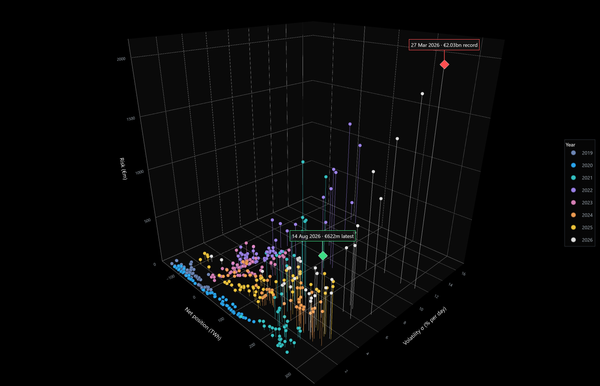
The post-Hormuz cliff edge
Prolonged closure jacks up near-term volatility, and sets the stage for an abrupt reversal: macroeconomic shock + demand destruction + new LNG supply wave


The European natural gas market is facing a contradictory reality from prolonged closure of the Strait of Hormuz.
A months-long closure of this vital LNG export route presents asymmetric upside risk to gas markets throughout 2026, and probably well into 2027. But it is a double-edged sword.
The longer commercial traffic is disrupted, the deeper the demand destruction it will precipitate in emerging Asian markets that were supposed to soak up the wave of new LNG supply that will hit the market later this decade.
Near-term price risk is skewed to the upside, supporting a bullish 2026-27 thesis. Further out, the picture becomes far less clear. The potential for the gas narrative to shift abruptly from wartime scarcity to a regime of structural excess rises every day that Hormuz is shut. The key variables are the duration of closure and speed of normalisation.
A quick reopening and lasting diplomatic solution would dull both near-term scarcity-driven volatility and the tail risk of a macroeconomic shock, global recession and a rapid loosening in physical market balances. But hopes of that optimistic scenario materialising are rapidly fading, as both sides in the US-Iran conflict dig in for a bruising war of economic attrition.
This week’s downloadable 100-slide Chart Deck is littered with evidence that Dutch TTF, the European gas benchmark, is starting to price in a ‘whipsaw scenario’: acute physical shortage fuelling volatility into next winter and beyond, followed – at some point – by a sudden reversal of conditions that could be almost as dramatic as the war itself. Let’s dive in.
Inside this week’s Chart Deck:
A tour through the TTF forward curve’s split personality (slides 17–19)
The TTF Sentiment Tracker, Risk Model and Storage-Speculation Nexus showing funds locking in front-end length but quietly cooling on the 2028 trade (slides 21–43)
The oil-vs-spot and US-vs-oil-indexed economics that are reshaping Asian procurement (slides 53–58)
How reshaped global LNG flows are absorbing the loss of Hormuz transits (slides 75–96)
Europe’s storage refill progress, injection rates vs seasonal norms, and how compressed spreads make it that bit harder (slides 15-16, 48-51)
The first LNG vessels to transit the Strait, and full inventory of all Hormuz transits (slides 76-81)

Member discussion: The post-Hormuz cliff edge
Read what members are saying. Subscribe to join the conversation.